Showing posts with label Dweller on the Threshold. Show all posts

Saturday, 22 January 2011

On the demons (or teachers?) within us

A few weeks back we had a pretty intense three day session of Gestalt-Therapy training. During one of the training sessions I realized some interesting parallels between the emotional state one of the group members was going through and the way the qliphothic forces of Tiphareth work, Tagimron.

What happened to him was - in a nutshell - that he struggled to accept beauty in the simple and straight forward way it presented itself to him. He was in love with a woman he recently got to know and showed all the obvious signs of being in love... Yet, when left to reflect on this experience he started to question his feelings and became entangled in an inner dispute on whether to accept his love as real or not. The translation of the Qliphoth Tagimron is 'The Disputers' and their nature is to inhibit or destroy the experience of beauty, as in a state of inner union with ones feelings. As I mentioned in the article On The Nature of the Qliphoth "they can take shape in any force that creates confusion rather than fusion of heart and mind" - and this is exactly what happened to the member of the group.


Or was it? While reflecting on it later that evening I realized the same symptoms could have been evoked by a blocked heart chakra, or his astrological Sun and Venus being overshadowed by Saturn or Pluto, or by a lack of Prithivi (earth) tattwa energy that failed to ground his mind in his body...


The many spirit faces to chose from...
 
(
here: the eight most servant pygmies
 from Dr. Faustus Vierfacher Höllenzwang,
in Scheible, Das Kloster, Vol.5) 
Finally I realized that the cupboard of magickal spirit models has so many drawers it seems easy to get lost in it? Does a blocked access to my own emotions stems from a lack of water energies in my body, does it represent a negative influence of Venus or maybe a state of over-charging Saturn influences? Is it due to a decane rulership that is currently activated in my horoscope or is it truly the influence of a Qliphoth such as Golohab? To be honest, I felt a little over-equipped with magickal spirit tools and needed to take a different approach.

I found it by taking a little philosophical detour... Plotin, Porphyry, Iamblichus, Proclus, the compilers of the Picatrix and many other sources explain that the influence of spirits on creation is organized in so called 'chains' (seirai in Greek). Theodor Hopfner in his wonderful introduction to the 1933 German edition of the Picatrix provides an elaborate and very insightful summary of this idea - which is likely to suffer from my English translation, but anyway here it is:


The characteristic of this form of Neoplatonism is that the emanations of the upper world are connected to the ones of the lower world by intermediate beings; the higher the gradation of these beings the more they resemble the character of demons and gods; yet the more they unite with physical matter the more they appear as spiritual forces asleep in all animals, plants, stones and all other creatures of nature. (...) We clearly see from the (teachings of the) Lauteren Brüder that the forces of the universal soul are changing their faces and that they can be perceived as forces, or angels of God, or spirits, or even Pneumata (depending on the level of emanation they are encountered at).
(Theodor Hopfner (ed.), Picatrix - Das Ziel der Weisen, 1933 p.xxvii)

Thus the Gods are the first emanation of the Universal Soul, each creating a sympathetic chain of their particular nature and influence reaching downwards into the lower spheres of creation. Ultimately each divine chain anchors in the four elements and thus becomes efficacious in all things created from these. If we follow this philosophy of nature than finding the right spirit to deal with a particular problem isn't a matter of an individual name or class. Instead it becomes a matter of identifying the right 'sympathetic chain' which is related to the forces in question. Once the chain is identified it is on us to chose on which level - or chain link - we decide to work. 


Well, who exactly is
teaching to whom?
So a problem that was generally identified to be related to an over-charging of fire, could be addressed on any link of the sympathetic chain related to the theme of fire. This approach opens a wide array of equally opportune possibilities to work with the matter at hands. Rather than finding the 'right or wrong remedy' it now is a question of which level or link of the chain is most accessible and easiest to work with for me... 


Obviously the higher we climb in the chain the more powerful and far-reaching the forces we work with become. A tattwa journey to meet the elementary ruler of fire is a very different approach than a ritual for Mars or a demonic evocation of the Golohab. Each approach has advantages and disadvantages which need to be examined in light of two main criteria: the nature and dimension of the problem at hands as well as the skills and expertise of the magician affected.

So rather than identifying the 'one and only' solution to the problem at hand - let's look for the teacher who can help us identifying the smallest possible improvement, the most simple next step we can take right now. Here are some choices: 

  • Your week is busy and you need to travel, so a Tattwa journey might be a great start as tattwa cards easily travel with you
  • Or maybe you have a vacation coming up and really want to dig into it - so a planetary rite or an evocation of the Qliphoth could be re-balancing act you need
  • Or maybe you feel exhausted and strained by the problem already, you didn't take action early on - then a refreshing bath and a night of rest and sleep in your temple under the incense clouds of herbs related to the problem might be a good choice
  • Or maybe you are just starting your magickal journey and these things sound tempting but out of reach for now - well, find a therapist or astrological consultant and start by opening up to someone competent you really trust


I guess what I am learning is... When working with our inner demons we rarely have a single partner to work with. But we are surrounded by sympathetic chains of spirit forces - familiar and unfamiliar, accessible and inaccessible, sympathetic and not so sympathetic ones. Yet, each of them has advise for us, none of them being right or wrong - but all of them being true and authentic in their own way. They all present an open hand - some smooth and some rough - for us to overcome the limitations we are facing... It is us who chose the teacher within us.
The demon Beulus kindly offering some flowers
to a magician in need of a teacher... or not?

(from Scheible, Doct. Iohannis Fausti Magiae Naturalis et Innaturalis, 1505)


Friday, 7 January 2011

The Serpent of Wisdom

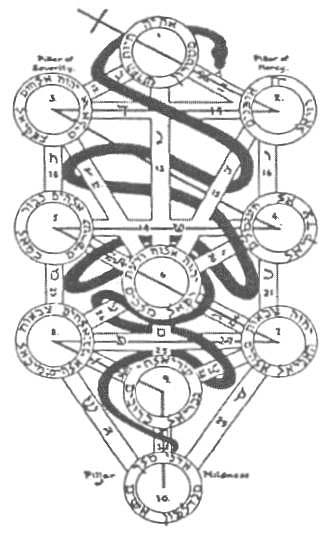
As part of the preparatory work on the Dweller on the Threshold article I redrew the famous serpent of the wisdom picture. The original picture looked like this and is rarely available in high resolution and - as far as I know - not free of copyright. Other versions were reproduced over time but often contain errors just like this example...

The picture depicts the Serpent of Wisdom coiling around the tree of life. It's body indicates the steps in the mystic ascension of the student on the Etz Chiim (Tree of Life). The sequence in which its body touches each path is especially important - as well as wether it crosses behind or in front of a path. If you are interested to learn more about it, I recommend Gareth Knight's essential 'A Practical Guide to Qabalistic Symbolism'. 

In light of the Dweller article - just take a look at the body of the snake below Tiphareth... Looks pretty much like the body of the serpent is shaping the veil of Paroketh.

The picture is available here in poster size as a free download to anyone interested (17 MB).

I won't claim copyright on it, so feel free to reproduce.

May the serpent bite its tail.

Wednesday, 5 January 2011

On Magic and Cognitive Dissonance


This short article started as a draft for a post on this page. I simply wanted to provide more context on how psychology and magic can walk side by side at times. A topic I have been deeply fascinated by since years and am still exploring... Since I started to write the article, it expanded and I finally decided to make it available as an Appendix to the Dweller on the Threshold article on myoccultcircle.com. Yet, as the inspiration for this text came from this blog I also feel it belongs here... So, in case you are prepared for a little longer read, I hope you'll enjoy.
::


In the paper on The Dweller on the Threshold I mentioned cognitive dissonance as a key concept in elementary rituals and overcoming the dweller. As this might be a new approach for some, let me share some further thoughts on this in an Appendix to the original article.

First things first: I have to admit I don't know a lot about the theory of 'cognitive dissonance'. A good friend of mine - the one with whom I am undertaking the Arbatel ritual cycle and who is the source of many of the ideas here and on my blog - just mentioned the term coming out of his ritual of Phul. What he said sounded so very convincing, so I looked up the term and it snapped... Thus, most of my entire theoretical background on the concept is summarized at Wikipedia and my biggest thanks goes out to my good friend for his wonderful inspiration! Being somewhat short on sociological theory on cognitive dissonance, I do think, however, I have learned some lessons about creating it in context of rituals and using it to change deeply rooted habits or negative assumptions about life. This is what I want to talk about, and mainly by sharing three examples on how to create and leverage deep states of cognitive dissonance.


First a brief attempt of a definition though:


  • "Cognitive dissonance is an uncomfortable feeling caused by holding conflicting ideas simultaneously." (link to source)
  • "Cognitive dissonance is a theory of human motivation that asserts that it is psychologically uncomfortable to hold contradictory cognitions. The theory is that dissonance, being unpleasant, motivates a person to change his cognition, attitude, or behavior." (link to source
Just to make sure we are all on the same page: cognitive dissonance itself is nothing more than an opportunity to break free from an established perspective by creating a contradicting or simply completely new type of related experience. However, it is our reaction to this experience that defines wether we can seize the opportunity. Cognitive Dissonance can be reduced by changing our attitudes, beliefs, and actions - just as well as it is reduced by rationalizing, justifying, blaming or denying. 

What I want to talk about in the following three examples is how a deep state of cognitive dissonance can be actively induced in our consciousness. It us and how we chose to react to the newly gained, yet initially unpleasant freedom of mind that make the real difference.
  • Zen Buddhism - The use of Kōans: This might be the best well known technique for creating cognitive dissonance. The teacher gives the student a Kōan to meditate on: that is a story, a saying or question that puzzles the rationale mind and cannot be solved by thinking, yet by an intuitive understanding only. One such example is the prompt: "Without thinking of good or evil, show me your original face before your mother and father were born." One of my relatives is a Zen priest and I once asked him about his most puzzling and tricky Kōan experience. He told me that there was one Kōan he meditated about for almost an entire year. He would go and see his master several times per week and give his best attempt of an answer to the Kōan. The master refused each time. One day he visited the master again and gave the exact same answer he had given during many months before. That day the master smiled and accepted his answer. When I asked him how that could be, my relative simply said: because that morning it wasn't my mind giving the answer but my entire body, starting from the understanding of my heart. - The effect of cognitive dissonance doesn't get much better to me than that.  


  • Ancient Ritual Magic - The use of the magic act: For us as magicians this might be the most familiar way of experiencing cognitive dissonance; even though I would think we rarely call it that way. Many wonderful examples of this ritual technique can be found in the Sefer ha-Razim. Let's take a look at one of them to better understand the way this works: In SHR II §372 - § 374 the method is explained how to interpret and understand the content of this book given by the angel Raziel to Adam. It advises the reader to take two doves, kill them with a copper double-bladed knife, one dove with each side of the knife. Then take out the entrails and cleanse them with water. Next create an incense mixture of myrrh, curcuma, white blossom, 72 seeds of white pepper, old wine, olibanum and honey. Then fill the entrails of the doves with the incense, dissect them into smaller parts (i.e. little dove sausages I guess?) and put them on lit coals before sunrise. During the three following days he has to wear white garment, be barefoot and recite the angel names of the specific month during which he came to ask his question of understanding the book. On the third day he is to bring the ashes of the dove entrails which was created by the coals during this time and prepare a house for his solitary work. He then spreads out the incensed ashes on the entire floor of the house and sleep on the bare floor covered by these ashes and recite the names of the angels again. "Sleep and don't talk to anybody. Then during the night the angels will come to you in a vision and not in mysteries and will reveal all things without any fear" (p.187). - Well, if this process doesn't build up some pretty heavy contradictions to how you normally tend to treat food, use incense or simply rest at night, I don't know what could do... The intense magical (preparatory) act is a wonderful example of the art and science to create a new and different state of consciousness - by opening an unconfined space of experiences that is completely out of reach for any previously created attitudes, beliefs or actions.             

  • Psychomagic - The use of the psychomagic act: The use of Psychomagic to create cognitive dissonance is least know to many of us as it is by far the youngest. Alejandro Jodorowsky developed this innovative technique and it is still to be proven wether it can be adapted by other magicians or simply is a beautiful account of one man's personal and highly creative way of healing. It involves aspects of both of the approaches explained before: Zen and ancient ritual magic. It uses the power of speaking to intuition rather than our minds, while also leveraging the contact to our subconsciousness by directly involving a concrete physical act to manifest our desire. Let me share just one example Jodorowsky gives in his book - but let me warn you as well - the quote is taken out of context and I can only recommend to read the full book to create some wonderful cognitive dissonances: "Beginning to understand the havoc, she came to ask me to prescribe an act that would allow her to forgive her father and thus overcome her hatred of men. I asked her to tell me at what moment her father had broken off relations with her. 'When I started menstruating,' she responded. It is common for a father to break relations with his daughter when she becomes a woman. He feels that he's lost his little girl who sat in his lap, and he has a hard time giving up that kind of intimacy, that contact. Right away I asked her where her father was buried; then I suggested that she go to his grave. 'There,' I told her, 'you bury, as close as possible to the body, cotton soaked in your mentrual blood, as well as a jar of honey. (...) The honey is there to breath in life with sweetness, to signify that it is not an aggressive act but rather a loving one, an attempt at communication. There! An example of a very simple psychomagic act that allowed the reactivation of a brutally broken relationship and at the same time the resumption of an emotional evolution interrupted by a shock." (from: Alejandro Jodorowsky, Psychomagic - Chapter Six: Examples of Psychomagic Acts)   

Now, what do we make of all this in our everyday lives? First, I guess we should feel the force of a huge wave of support behind us to break free from the limits that hold us confined. We are not alone in our struggle, but people in all cultures before and after us have been on the same journey towards liberation. Thus each culture has discovered its own authentic expression and technique of putting cognitive dissonance into the service of healing what has been bruised or incarcerated. It is us who have to chose.

Secondly, on every occasion we are confused, angry or simply lost we are facing an opportunity to break free. Each time we are thrown out of the comfort of our personality, life presents a chance to break free from the Guardian of the Threshold. Just like we are blessed with techniques for creating cognitive dissonances - we are also blessed with resources and material to work with. One day at a time.  

Finally, I guess one of the main problems in seizing these opportunities lies in the nature of how we perceive and engage with our emotions (Netzach), thoughts (Hod) or sensory impressions (Malkuth). All three of them take shape in our minds either unconsciously and therefore completely unquestioned or - if we are lucky - consciously but as an assumed part of 'truth' or 'reality'. The way we normally reflect on our emotions, thoughts and bodily perceptions is similar to a fish under water: our consciousness is completely involved and absorbed, we think we depend on them just like a fish on being enclosed by water. Thus we fear leaving what is dear and familiar to us and to raise our minds out of the water. Unfortunately that is the first thing we have to do in order to start surfing the waves...

May all of our Great Works start with our fears.


"It happens that I am sick of my feet and my nails
and my hair and my shadow.
It so happens I am sick of being a man.
Still it would be marvelous
to terrify a law clerk with a cut lilly,
or kill a nun with a blow on the ear.
It would be great
to go through the streets with a green knife
letting out yells until I die of the cold."

(from Neruda and Vallejo: Selected Poems, translated by Robert Bly)


Saturday, 1 January 2011

On the Dweller on the Threshold


Welcome to 2011 everybody! I hope you had a wonderful transition and things are looking good for you as we are beginning a new year...

As mentioned earlier I have been working on an analysis of the experience or entity called the 'Dweller on the Threshold'. Other expressions for it are 'Guardian of the Threshold', 'Dominus Limini' or the 'Veil of Paroketh'.

While the term is often referenced by authors on Western Occultism it is rarely explained in depth. Having spoken about the Qliphoth in an earlier article and post, this paper presents a more accessible perspective on how to face our inner demons while ascending on the Tree of Life... 

Originally I wrote the article in 2005 in a shorter version in German. Since then I had the chance to continue my encounters with the Dweller and learn from many other people and entities. This led to the current revised and expanded version. Most importantly I added a critical analysis of the Gematria of the word 'Paroketh'.

I hope the article will help you in a similar way as it did me in bringing it together. While we all must make our own experiences - and Gnosis can only be achieved through individual study and practice - my intention was to provide a thorough theoretical basis for your own experiences and explorations. 

The article is now available on myoccultcircle.com in full length. It is structured in three main parts:

  1. Introduction
  2. Below the veil of Paroketh - The illusion of the Ego
  3. Lifting the veil of Paroketh - On the nature of the Dweller
If time allows I will add a fourth part over time. This will cover the psychological perspective on C.G. Jung's concept of the Shadow which is closely related to the Dweller on the Threshold. Establishing a thorough understanding on how this Shadow affects us 'outside of the temple' in everyday lives is a lesson that is far to easily overlooked.

"The higher the learner ascends, the greater the dangers. The angels and archons storm against him to strike him out. A fire that comes from within him threatens to burn him."

(excerpt from the ascent of the soul in Merkaba mystic, 
according to Gershom Sholem, Die jüdische Mystik 
in ihren Hauptströmungen; 1996, p.56)


Monday, 20 December 2010

Dweller on the threshold

Last night I decided to take on a larger project over the holiday season to be published on www.myoccultcircle.com in early January. 


A few years back I was deeply involved in practical work and research on the concept of the 'dweller on the threshold' as introduced by Bulwer-Lytton. Immersion into this concept and its practical appliance in context of kabbalistic operations was a major element on my journey from Yesod to Hod on the Etz Chiim (tree of life) - which in essence took almost 2 years.


While there is a good chunk of information available on the internet already (the most obvious being the Dweller article on Wikipedia) my focus was to bring together the kabbalistic and psychological perspective to make this concept more accessible. I would have loved to use the publications of other people from this viewpoint but unfortunately couldn't find anything. 


With additions over time this resulted in a 19 pages article with lots of references and footnotes. I will try to bring most of it online (footnotes are a pain with iWeb!) and probably split it into three main chapters. Most of the work will be the actual translation as all of it is in German currently.


So in case you are interested in working on the veil of Paroketh, stay tuned.